.png)
Future Skills Academy for India Nuclear Energy Mission and SMR with Digital Cyber and Critical Infrastructure

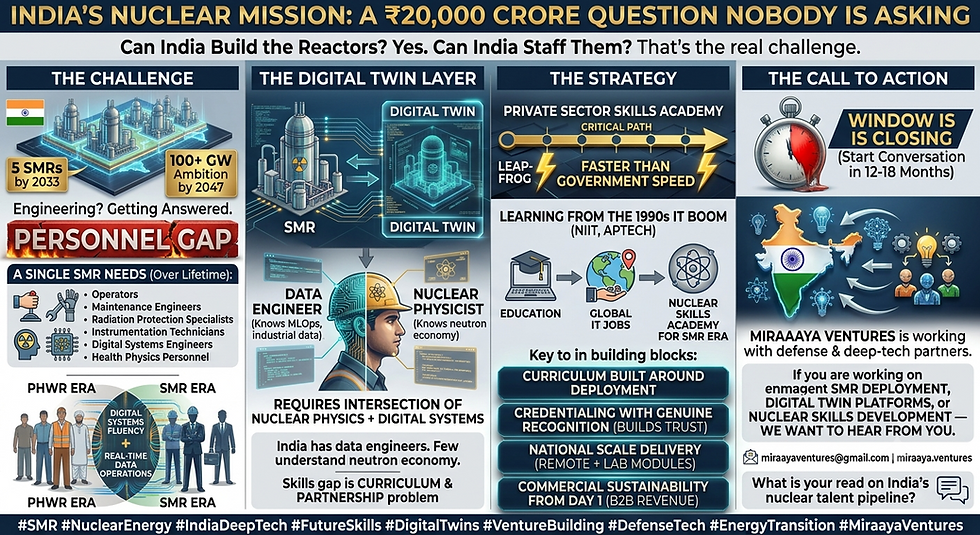
India’s nuclear ambition is moving from a specialist energy issue to a national capability question. The Union Budget 2025-26 announced a Nuclear Energy Mission with an outlay of ₹20,000 crore to support indigenous small modular reactor development, with the stated aim of developing at least five SMRs by 2033. The wider policy direction also points to a much larger long-term nuclear role, including the national conversation around 100 GW of nuclear capacity by 2047.
That scale will not be achieved by reactors alone. It will need trained people, qualified suppliers, secure digital systems, cyber-aware operations, nuclear-grade construction, and disciplined project and asset management. This is where an India-focused Nuclear & Critical Infrastructure Skills Academy becomes more than a training idea. It becomes part of the industrial base.

India’s nuclear push now depends on workforce depth
India already has a mature civil nuclear foundation. The country has decades of experience with pressurised heavy water reactors, a domestic atomic energy programme, uranium fuel-cycle capabilities, and a regulatory framework shaped by the Atomic Energy Act, 1962, and the Civil Liability for Nuclear Damage Act, 2010. The national regulator oversees safety in nuclear and radiation facilities, while the atomic energy establishment has built operating experience across power, research, fuel, and waste management.
The new phase is different in three ways.
First, the ambition is larger. Nuclear energy is being linked to clean power, energy security, industrial growth, and firm low-carbon electricity. Solar and wind can generate large volumes of electricity, but they are variable. Nuclear power can provide steady generation, which matters for grids, heavy industry, green hydrogen, data centres, rail, defence manufacturing, and desalination.
Second, the industrial model is changing. India’s nuclear sector has historically relied on public-sector leadership, with private firms participating mainly as suppliers, fabricators, contractors, engineering partners, and service providers. The policy direction now points to broader private-sector participation, especially in manufacturing, construction, digital systems, research support, and future SMR deployment models, subject to legal and regulatory change.
Third, the technical skill mix is widening. Traditional nuclear training focused on reactor physics, radiation protection, mechanical systems, electrical systems, chemistry, safety, and operations. Those remain essential. But new projects also require:
Cybersecurity for operational technology and industrial control systems
Digital engineering for design, simulation, configuration, and commissioning
Critical infrastructure protection for physical and digital assets
Modular construction and nuclear-grade supply chains
Project controls for long build-cycle, high-assurance assets
Asset management for plants expected to operate safely for decades
This is the gap an India Nuclear Skills Training Academy should address.
SMRs change the training problem (Future Skills Academy)
Small modular reactors are often described as smaller, factory-built nuclear plants. That is partly true, but it can hide the complexity. SMRs still require nuclear-grade design, licensing, manufacturing, siting, emergency planning, quality assurance, operations, maintenance, and decommissioning.
The difference is that modular reactors could change how nuclear projects are built and repeated. A large single-unit plant is often treated as a mega-project. An SMR programme may involve repeatable modules, serial manufacturing, pre-qualified suppliers, standardised designs, and distributed deployment across industrial clusters, ports, mining belts, remote grids, or energy-intensive facilities.
That creates a new skills profile.
Capability area | Why it matters for SMRs | Example training need |
Nuclear fundamentals | Every worker must understand safety, radiation, and defence-in-depth | Reactor basics, shielding, contamination control, emergency response |
Modular manufacturing | Repeatability depends on strict process control | Welding qualification, inspection plans, digital traceability |
Digital engineering | Designs must remain consistent from model to site | 3D models, configuration management, digital handover |
Cybersecurity | SMRs will use advanced control and monitoring systems | Industrial network segmentation, incident response, secure maintenance |
Project controls | Modular projects still face schedule, cost, and interface risk | Earned value basics, contract packages, risk registers |
Asset management | Long operating life demands disciplined maintenance | Condition monitoring, spares planning, ageing management |
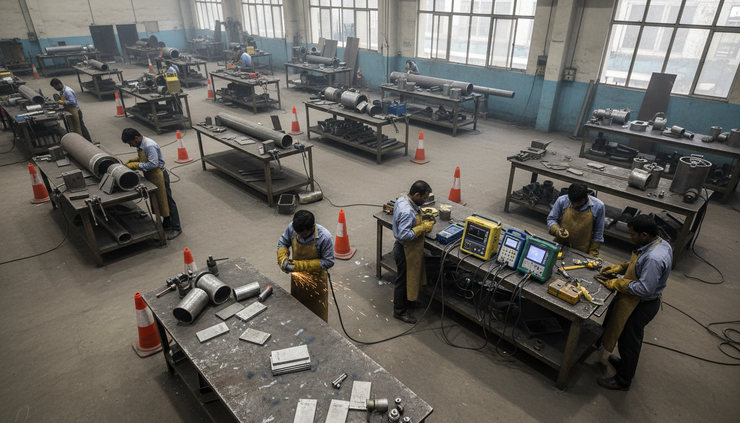
The emerging SMR workforce cannot be trained only through classroom instruction. It needs simulators, mock-ups, digital twins, cyber ranges, welding and inspection labs, site-readiness exercises, and scenario-based assessments.

The SHANTI Act shows why nuclear skills must include global readiness
India’s nuclear ecosystem does not operate in isolation. Civil nuclear projects involve safeguards, export controls, fuel supply, technology cooperation, liability frameworks, standards, and cross-border supply chains. Policy proposals such as the SHANTI Act in the United States are often discussed in this wider context of expanding civil nuclear cooperation with India.
The practical lesson is clear. India’s workforce must be ready for global nuclear expectations, even when projects are built locally.
For a manufacturer, this means documentation discipline. A nuclear component is not accepted only because it looks correct. It must carry evidence: material certificates, heat numbers, inspection records, non-destructive examination reports, calibration logs, deviation approvals, and lifetime traceability.
For a digital engineer, it means configuration control. If a drawing, software version, alarm setting, or safety-related data point changes, the change must be reviewed, approved, recorded, and verified.
For a cybersecurity engineer, it means understanding that nuclear cyber risk is not the same as ordinary enterprise cyber risk. A reactor plant or fuel-cycle facility includes operational technology, safety systems, physical security zones, radiation monitoring, emergency systems, and strict access control. A careless patch, unknown device, or poorly managed remote connection can create operational risk.
For a project manager, it means accepting that nuclear schedules cannot be managed like ordinary construction schedules. Quality holds, regulatory reviews, design freezes, interface tests, and commissioning stages are part of the project logic.
That is why nuclear workforce development must be broader than employment training. It must develop regulated-industry behaviour.
What a Nuclear & Critical Infrastructure Skills Academy should teach
A serious academy should not offer scattered short courses with impressive names. It should build progressive pathways, from foundation awareness to job-ready technical competence and later specialist certification.
A strong India-focused model can be built around six learning pillars.
Nuclear and radiation safety fundamentals
Every programme should begin with nuclear safety culture. This includes basic reactor concepts, radiation protection, contamination control, emergency preparedness, human performance, safety classification, and defence-in-depth.
The International Atomic Energy Agency has long stressed safety culture, graded approach, and management systems in nuclear activities. These are not abstract ideas. They affect how workers fill checklists, stop unsafe work, report near misses, handle tools, and maintain records.
A parent considering this career path for a postgraduate student should see this clearly: nuclear work is not only for reactor physicists. It needs mechanical engineers, civil engineers, electrical engineers, chemists, data engineers, cybersecurity specialists, project planners, procurement professionals, and quality inspectors who can all work within a safety-led system.
SMR engineering and modular delivery
SMR training should cover reactor categories, passive safety concepts, modular fabrication, transport limits, siting factors, commissioning, and operational readiness. It should also teach students to compare SMRs with large reactors without hype.
Useful exercises could include:
Mapping the lifecycle of an SMR module from factory to site
Identifying quality gates in a modular manufacturing process
Studying how standardisation reduces risk only when change is controlled
Running site-readiness checks for power, water, access, security, and emergency response
This prepares learners for future roles in design support, manufacturing, procurement, construction, and operations.
Digital engineering for nuclear-grade projects
Nuclear projects generate vast technical information. Drawings, models, codes, safety cases, inspection files, commissioning records, maintenance histories, and change logs must remain accurate over decades.
Digital engineering training should include:
Building information modelling for complex infrastructure
Plant information models and asset hierarchies
Digital twin concepts for monitoring and training
Document control and configuration management
Requirements traceability from design to commissioning
Data quality, access control, and long-term record retention
The goal is not to chase software fashion. The goal is to ensure the right information is available, trusted, and controlled when safety decisions are made.
Cybersecurity for nuclear and critical infrastructure
India’s critical infrastructure is rapidly digitising. Power grids, ports, refineries, rail networks, water systems, telecom networks, and defence-linked supply chains all rely on industrial control systems. Nuclear facilities sit at the high end of this risk category.
A nuclear cyber curriculum should cover both information technology and operational technology. It should include industrial protocols, network zoning, secure remote access, asset inventory, vulnerability management, incident response, backup strategy, insider risk, and supply-chain cyber assurance.
Cyber labs should simulate realistic scenarios without exposing real facilities. For example, learners can practise detecting abnormal network traffic between a workstation and a controller, responding to unauthorised USB use, or restoring a monitoring system after a controlled failure.

Nuclear-grade civil, mechanical, and electrical infrastructure
Civil and infrastructure skills deserve more attention. A nuclear or SMR site depends on seismic design, concrete quality, embedded systems, cooling systems, ventilation, fire protection, cable routing, earthing, physical security, drainage, access roads, and heavy-lift planning.
Industrial localisation will need fabrication shops and contractors that can meet nuclear expectations. This includes:
Qualified welding and brazing procedures
Traceable materials and consumables
Non-destructive testing capability
Clean assembly practices
Calibration discipline
Quality plans and inspection test plans
Supplier audits and corrective action systems
Such skills also transfer to other high-assurance sectors, including defence production, aerospace supply, high-speed rail, metro systems, oil and gas, data centres, and large process plants.
Project, programme, and asset management
The final pillar is management discipline. India does not only need engineers who can design systems. It needs teams that can deliver and maintain complex assets safely.
Training should cover project planning, risk management, contract interfaces, cost control, readiness reviews, commissioning, shutdown planning, spares strategy, maintenance optimisation, ageing management, and decommissioning basics.
The phrase Nuclear skills, Nuclear training specialist, Training academy, Future skills of Employment and Workforce can sound like a career brochure, but in this sector it points to a real national issue: projects fail when skills are too narrow, too late, or too disconnected from actual site work.
How the academy can serve industry, Universities, PSUs, and Students
A national academy model should work across India, not only near existing nuclear sites. It can use a hub-and-spoke format, with central specialist labs and regional partner centres linked to universities, public-sector training institutes, industrial clusters, and technical campuses.
For universities, the academy can provide add-on credits, laboratory modules, faculty development, internships, and capstone projects. Many postgraduate students study power systems, mechanical design, materials, data science, or cybersecurity, but never see how these subjects connect inside regulated infrastructure.
For PSUs and government-linked entities, the academy can support upskilling in safety culture, digital records, cyber hygiene, vendor management, maintenance planning, and project controls. Such programmes can be tailored for experienced engineers who do not need basic theory but do need sector-specific practice.
For private industry, the academy can prepare suppliers for nuclear-grade expectations before tenders arrive. This is vital. A company cannot become a credible nuclear supplier at the last minute. It must build procedures, documentation, trained staff, qualified processes, and audit readiness early.
For students and parents, the academy can translate a complex sector into visible career pathways:
Nuclear safety technician
Radiation protection assistant
SMR design support engineer
Quality and inspection engineer
Industrial cybersecurity analyst
Digital engineering modeller
Commissioning support engineer
Asset management analyst
Project controls engineer
Supplier quality coordinator
These roles will not all sit inside reactor operators. Many will exist across engineering firms, fabrication units, inspection agencies, construction contractors, digital infrastructure teams, cybersecurity teams, research centres, and public-sector organisations.
The real opportunity is capability before demand peaks
India’s nuclear expansion will take time. Licensing, public acceptance, land, finance, safety review, fuel assurance, liability, and supply-chain readiness all matter. SMRs are promising, but they are not a shortcut around nuclear discipline.
That is exactly why skills development should start early.
If training waits until projects are sanctioned, the country will face shortages in quality inspectors, nuclear-aware cyber professionals, digital configuration specialists, commissioning engineers, and supplier auditors. If training begins now, India can build a workforce that supports local industry, strengthens PSUs, gives universities a future-facing curriculum, and improves the credibility of private participation.
The Nuclear Energy Mission can fund technology development. Policy reform can open new participation models. International cooperation can support supply chains. But people will convert policy into safe capacity.
A Nuclear & Critical Infrastructure Skills Academy should be designed around that truth. It should connect nuclear science with SMR delivery, digital engineering with cyber defence, and project management with long-life asset safety. India’s nuclear future will be built by reactors, but it will be secured by the workforce behind them.
Comments