.png)
India Is Building Nuclear Reactors. Who Will Run Them?

Addressing this Blind Spot in ₹20,000 Crore in India's Nuclear Energy Mission
India made a quiet announcement that deserves far louder attention.
In the Union Budget 2025–26, the government committed ₹20,000 crore to the Nuclear Energy Mission, with Small Modular Reactors (SMRs) at the centre of the ambition. The plan: at least five indigenous SMRs by 2033, a meaningful share of India's energy mix by 2047, and a technology platform that could anchor the country's next industrial era.
The engineering question — can India build the reactors? — is getting answered in national laboratories, PSU boardrooms, and a handful of deep-tech ventures already in this space.
The question almost nobody is asking publicly is the one that will actually decide whether the mission lands: where will the people come from?
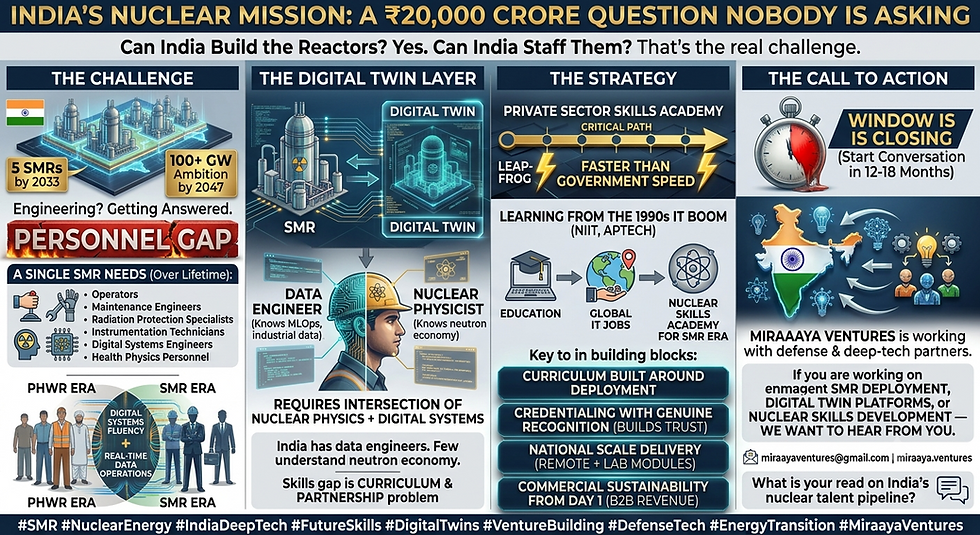
The Scale of the Gap Is Not Obvious Until You Do the Maths
A single SMR requires, over its operating lifetime, a sustained pool of operators, maintenance engineers, radiation protection specialists, instrumentation technicians, digital systems engineers, and health physics personnel. Multiply that by five units by 2033, and again by the ambition of 100+ GW of nuclear capacity by 2047, and you are looking at tens of thousands of trained professionals India does not currently have a clear pipeline to produce.
The existing nuclear workforce — trained largely through BARC, NPCIL apprenticeships, and a handful of engineering programmes — was designed around the current fleet of Pressurised Heavy Water Reactors. SMRs are a meaningfully different technology. They are more automated, more software-intensive, and in many design variants, more deeply integrated with digital twin monitoring systems than any reactor India has operated at scale.
That last point matters more than most people in the policy conversation have acknowledged yet. The operational model for an SMR is not just "learn nuclear, apply it here." It requires people who sit at the intersection of nuclear physics, digital systems, and real-time data operations. That combination does not currently exist in meaningful numbers in the Indian talent market.
Why Deep Tech Ventures Are Actually the Faster Path in Nuclear Energy Mission
Government infrastructure like BARC, NPCIL, and the Department of Atomic Energy are doing serious work, and their timelines are what they are.
What can move faster is a private-sector training and skills academy model, built in close partnership with the national programme but operating with the pace and commercial discipline of a technology business.
This is not a theoretical model. It is the same logic that built India's IT training ecosystem in the 1990s, which ultimately produced the global workforce India's software industry runs on. The gap between what government education could supply and what the industry needed was filled by private institutions — NIIT, Aptech, and eventually corporate academies inside the large IT firms — that designed their curricula around the actual job requirements of their clients, iterated fast, and certified people to a standard the industry recognised.
A nuclear skills academy designed for the SMR era needs to do the same thing: build curriculum in partnership with the technology platforms being deployed, certify against the real competency frameworks the operators will use, and produce talent at the pace the deployment timeline demands.
The Digital Twin Layer Changes Everything
One element that separates the SMR talent challenge from any previous nuclear skills question in India is the digital twin integration.
Modern SMR designs — including the designs most likely to enter India's programme — assume continuous digital twin monitoring: real-time simulation models running in parallel with the physical plant, used for predictive maintenance, operational optimisation, and safety verification. Running these systems is not purely a nuclear job. It sits closer to the work of an industrial data engineer or an MLOps specialist who also understands reactor physics.
India currently produces large numbers of data engineers. It produces very few who also understand the neutron economy of a reactor. The skills academy question is, at its core, a curriculum design and industry partnership question: how do you create a structured pathway that moves a qualified data engineer or instrumentation specialist into this adjacent domain, with the rigour that nuclear safety requires but at a speed the deployment schedule demands?
This is a solvable problem. It requires someone to pick it up.
What the Venture Building Angle Looks Like
From where Miraaya Ventures sits — working at the intersection of deep tech, institutional partnerships, and commercial execution — this is one of the clearest venture building opportunities we see in the Indian market right now.
The components that need to exist:
A curriculum built around real deployment requirements. Not a generic nuclear syllabus, but a competency framework co-designed with the technology platforms and operators who will actually use these people.
A certifying body or partnership with institutional credibility. The nuclear sector operates on trust. Any skills programme that wants industry adoption needs either government recognition or a partnership with an established credentialling institution.
A digital-first delivery model. The talent pool that needs to be reached is not concentrated in a few cities. A programme that can operate at national scale needs to be able to deliver the non-classified, non-lab components remotely, with the supervised lab components structured as intensive modules.
Commercial sustainability from day one. A training programme that depends on grant funding to survive will not survive the policy cycles. The model needs a B2B revenue structure — corporate training contracts with the operators and technology vendors who need these people — from the moment it launches.
None of these components is exotic. What is rare is the combination of nuclear domain knowledge, digital systems fluency, and commercial execution capability in one team. That combination is what turns a well-intentioned programme into a venture that actually scales.
The Conversation That Needs to Happen Now
India's window to get ahead of the SMR talent curve is not indefinitely open. If the first reactors come online in 2033 and the training infrastructure is still being debated in 2031, the programme either slips its timeline or imports expertise at a cost and dependency that undercuts the whole rationale for indigenous nuclear capability.
The conversation between the technology developers, the national programme, and the organisations capable of building credible training infrastructure needs to start in the next 12–18 months — not because that is a comfortable horizon, but because training cycles are long and the dependency chain works backwards from the deployment date.
Miraaya Ventures is actively working with partners in the defense and deep-tech space on exactly this question. If you are working on SMR deployment, digital twin platforms for nuclear infrastructure, or nuclear skills development and want to think through the venture architecture, we would like to hear from you.
Miraaya Ventures Pvt Ltd, a venture building and advisory firm is working at the intersection of deep tech, national security infrastructure, and B2B commercial growth. Miraaya works with founders, institutions, and corporate partners to build ventures that bridge advanced engineering with durable commercial models.
Reach us at miraayaventures@gmail.com or through miraaya.ventures
Tags: SMR India, Nuclear Energy Mission, Future Skills, Deep Tech, Digital Twins, Venture Building, Nuclear Training, Defense Tech India
Comments